Tuesday, April 23, 2013

"Crab Walk 'til e meet Kiss-Kiss" - Language Evolution

Linguistical research within anthropology typically looks at the history of language, the evolution of our (or at times animals') biology in order to create language and how language can help to create culture. It studies language histories to see the evolution of a language within one culture or how as cultures assimilate languages can also at time amalgamate based on crosses within societies that mix together.

Sound interesting? For this blog post I'm going to be looking at Creole through the eyes of anthropologist Douglas Carl Reeser's article, "Language and Everyday Life in Belize". Douglas Carl Reeser is a doctoral candidate at the University of South Florida. He is currently working on his dissertation based on research in southern Belize, examining the intersection of State-provided health care with a number of ethnic-based traditional medicines.The term Creole comes from the Portuguese word, crioulo, which meant literally a slave born in the master's household. In the 16th century, the term came to include any French, Spanish, or Portuguese settlers in the West Indies and Latin America (Caver and Williams 2006). Many of the original Creoles were French who fled Haiti during a slave insurrection and landed on the northern Gulf Coast, they are the ancestors of people who still today live in northwestern Florida and the Mississippi and Louisiana coast, most notably in New Orleans.

Today there are many Creole languages. In fact, Creole languages are spoken widely on every continent except for Antarctica. The language began as a mixture of French, Spanish, and Portuguese but when Louisiana Creoles mixed with English speaking Americans, after the Lousiana Purchase, the language adapted again and became a mix of Creole and English. Creole thus becomes a pidgin language in it's adaptability, it is a language that simplifies the languages of 2 or more groups in order to have a basic line of communication.

Douglas Carl Resser did his language research in Belize where he was trying to learn about basic fundamentals of everyday life. His research took him to a finer understanding of Kriol (the form of Creole spoken there). "There are plenty of English words in any given Kriol sentence or two, but they are surrounded by words unfamiliar and foreign, such that many visitors to Belize do not understand the language" (Reeser 2013). He felt his time there was giving him plenty of information and a mastery of the language but every once and a while there would be whole sentences he wouldn't understand, or pieces in sentences that just left him baffled.

The answer to his riddle led within Proverbs. Proverbs are quotes of wisdom that are considered to be a cultural universal, meaning every community around the world has them. Resser was told from one of his informants, "You fas like crofi?" (Reeser 2013) and he didn't even know how to respond. This was a Belizean proverb meaning he was overly inquisitive. Proverbs don't have easily created translations across languages and so he began to realize that his gaps in knowledge within the language were coming from a wide use of proverbs.

"Proverbs help explain complex, difficult, or ambiguous situations by relating them to phrases that are often just as difficult to understand – unless you have intimate knowledge of the language, history, and culture from which the proverb originates. In contexts where language use is thick with proverbs, learning the language is then only one step towards understanding it" (Reeser 2013).

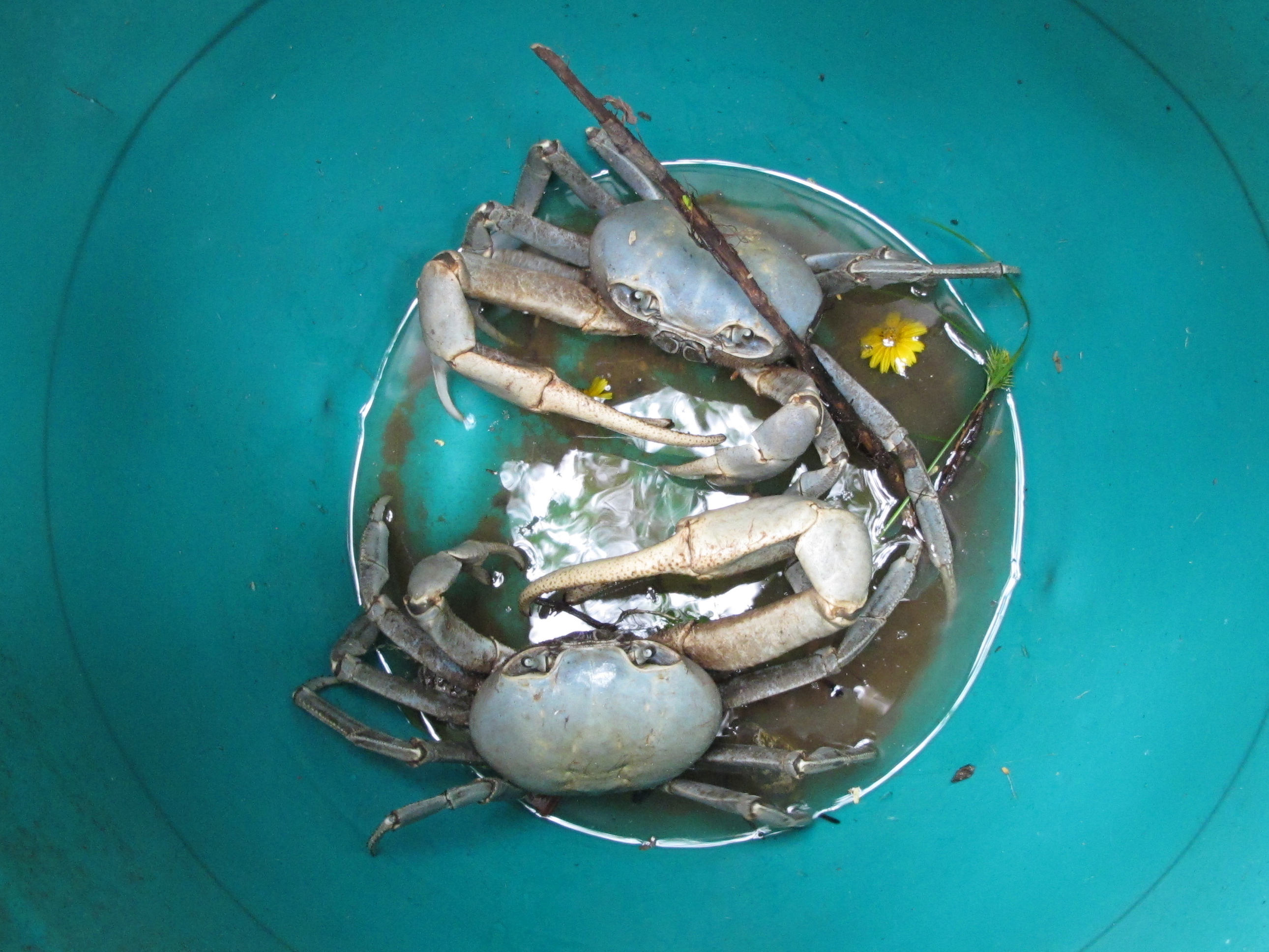
The title of this work, "Crab Walk 'til e meet Kiss Kiss" is a Belizean proverb referring to the trappings of life. Kiss-Kiss is the name of tongs that they use in their crabbing techniques. The crab walks freely with no cares in the world until it is snatched up by kiss-kiss. Who else out there is getting hungry? What are some other languages that have evolved over time? Has the English language? Along with proverbs what are other aspects of language that are easily lost in translation?


References

Caver, Helen Bush and Williams, Mary T. 2006. Creoles. Countries and their Cultures. http://www.everyculture.com/multi/Bu-Dr/Creoles.html. Accessed April 23rd, 2013.

Reeser, Douglas Carl. 2013. Language and Everyday Life in Belize. Anthropology News. http://www.anthropology-news.org/index.php/2013/04/16/speaking-in-proverbs/. Accessed April 23rd, 2013.

Thursday, April 18, 2013

Bringing it Together

     This blog started out with an overview of anthropology. Then quickly went to a post about religion and then on to some posts about archaeology. I'd like to continue the archaeology discussion here a bit and try and bring some of this together. Each of the four fields of anthropology (recall: cultural, archaeology, biological and linguistics from the first post) has its own claim to fame and its own uniqueness that makes it worthy of study and important to the whole field of anthroplogy. I just finished reading an article by Monica L. Smith, entitled "Archaeology as a Gateway to the Four Fields" (2009) in which Smith details some of the reasons why archaeology tends to be the way in which many people come to learn about anthropology for the first time. Monica L. Smith got her PhD at the University of Michigan and she is currently a professor at UCLA. Her subfield is archaeology and she specializes in urbanism, economic networks, consumption and material culture, anthropology of food, comparative historical archaeology; South Asia, Mediterranean, Southwestern U.S.

Why Archaeology?

     Archaeology is the subfield with the biggest public media presence. The media allows students to gain a curiousity about what archaeology really is and this gives college professors the opportunity to discuss archaeology and the relation it has to the other fields. Smith (2009) says that she "teaches a large introduction to archaeology course, and with 400 students in fall 2009 it is one of the largest social science courses at (her) university. Many students enroll for general education credits and are unlikely to take another anthropology course" (26). As we discussed in the last post characters like Indiana Jones or Lara Croft: Tomb Raider put archaeology into the public eye and these introductory courses are a professor's chance to capture the interest of students for anthropology.

Archaeology 101

     When Professor Smith was an assistant professor, at the time she wrote this article, she taught the intro class for archaeology. She pulled away from the idea that archaeology was just about digging up "old stuff" (26). She wanted students to realize that archaeology was all about human interaction, and specifically human interaction with material culture. "I start the course with a discussion of trash as a ubiquitous and meaningful signature of human activity: a banana peel that is not a clue about our local environment but a marker of robust trade connections, a box of dental floss that reveals how specialized our production and consumption processes have become, a burnt-out birthday candle that shows how symbolism can transform objects beyond the concept of practical utility, a penny with scraped-off bubblegum stuck to it that reveals how context determines the perceived worth of an object" (Smith: 26). This idea of modernizing the archaeological process is one that is echoed in many introductory classes around the country.


Bringing it together

     As her course continues she brings the other three subfields into the conversation. She talks about the ways in which the material culture of our ancestors through Homo and earlier, such as australopithecenes, can tell about the history of our interactions and how evolutionary changes in our body structure also help to give pieces to the puzzle of modern day humanity. In the area of linguistics she discusses the interaction with signs and visual histories through rock paintings and the advent of writing. She also discusses ideas about the process in which sound was codified into written symbols and words. Finally she goes into how archaeology works with cultural anthropology, two subfields that are very closely linked. Cultural anthropology being largely the creation and interaction of social groups she suggests that archaeology has a role of "examining the material evidence for socially cohesive acts such as monument construction and shared rituals, as well as socially divisive acts such as warfare" (Smith: 26).

     The four subfields only work when there are cross compared with each other. If you look to studies and universities outside of America there is only one field: anthropology and thus the four parts are always working as one. "Cultural perspectives also bring the class full circle, enabling students to critically assess why the past as a concept has value for present-day people and how abstract notions of identity are materialized through archaeological remains" (Smith: 26).

References:

2009. Smith, Monica L. "Archaeology as a Gateway to the Four Fields". Anthropology News. (50, 9). December 2009. p. 26.

UCLA: Anthropology. Monica L. Smith. http://www.anthro.ucla.edu/people/faculty?lid=1325. Accessed April 18th, 2013.

Monday, March 25, 2013

Archaeologist or Treasure Hunter?

     At the time of the birth of archaeology, archaeologists weren't actually archaeologists yet. Try saying that three times fast! They were actually antiquarians, people who were just really interested in old stuff from the past. They usually would find it in ruined cities, villages, or tribal sites clean it up and display it somewhere in their home. They wouldn't know much about what it was, what it's use was, who owned it or how it came to be where they found it. It just looked really pretty.
Ooooo, pretty! Yes, but is it art?
 
     The first moments of archaeology happened synchonistically around the 10th century in both the Middle East and Egypt and also in China. In Egypt, Muslim historians were beginning to take interest in Egyptian hieroglyphics and art, as in China "modern" Chinese gentry began to show an interest in ancient Chinese artworks. The interest, like mentioned above, was purely in the aesthetic value of the works taken and displayed. This phenomena was seen again during Renaissance Europe when Roman scholars Flavio Blondo and Ciriaco de Pizzicolli attempted to map the topography of Italy.The first ever real excavation took place in the ruined city of Pompeii and Herculaneum in the 18th century.
 
Indiana Jones the Treasure Hunter
     Indiana Jones is a perfect way of visualizing the crosses and distinct differences between archaeology and treasure hunting. By day he is a British professor of archaeology, he teaches his students all they need to know about archaeology, the occult and Egyptology. He studies ancient tomes that are in museums and discusses cultural impact on cultures both long dead and presently existing. He could be considered the first Ethnoarchaeologist. However his methods for obtaining new items for the university and the museum are where he sheds the guise of archaeologist and becomes a treasure hunter.


Professor Jones the Archaeologist
     By going into these countries, without permission from the ruling state and walking into the "site" without given consent from the descendants of the people who built it he is breaking several important laws that fall under the protection of archaeological sites. However, one might say that in the time period of the films those laws weren't in place, especially in the areas he travels to and you would be right. However, since the mid 1800s many archaeologists have talked of the moral code that they are responsible for upholding preventing them from removing objects of heritage from their physical present day owners.


     Today most countries have some form of legal document preventing archaeologists from working for the highest bidder. They have a right to unearth, clean, study, document and respond on items found in an archaeological site. They then have a greater responsibility to give these items, or at times human remains back to the present day owner of them. In America, we have UNESCO and NAGPRA laws which account for the ownership of most of the Native American and Prehistoric American resources found.
     So those of you who are interested in becoming archaeologists because you think you might snatch the crystal skull and sell it for a few billion dollars... stop watching movies! Just kidding, Indiana Jones was definitely in my mind when I first started studying anthropology. Although I have yet to crack a whip or have a poison dart shot at me, it has definitely been a world wide adventure in cultural thought.

Have a thought or a question? Ask me!


Suggested Further Reading:
A history of archaeological thought by Bruce Trigger
Call number: CC100.T75 2006 
Can You Dig it? An article presented in The Economist. http://www.economist.com/node/1056932
 
*Indiana Jones pictures taken from Hollywood.com accessed 3/25/2013
 
An additional note on the further reading. Bruce Trigger is one of my heroes in the archaeological world. He was at times an anthropologist but is mostly credited for archaeology. Although he did do a great deal of digging in his life his passion was definitely teaching and theory. His book listed above is one of the most comprehensive histories of archaeology from it's period in antiquarianism to it's multi-faceted present.
 
Enjoy!


Tuesday, March 12, 2013

Shipwreck Ahoy!

Yo-ho-ho mateys! This blog post be about shipwrecks, below ye can read to your heart's merriment about the three most interesting shipwrecks as defined by Archaeology magazine. The magazine lists the top ten and discusses them so, to learn more I suggest ye cough up some doubloons and by the issue.


     The first one we look at is off the coast of Turkey,  at Cape Gelidonya. It is from the Bronze Age  meaning it is quite old, in fact it is one of the oldest shipwrecks discovered to this day. The shipwreck at Cape Gelidona, excavated by the father of underwater archaeology George Bass was the first ancient shipwreck to be excavated in its entirety by archaeologists. It was either Cypriot or Syrian in origin and was a treasure trove of Bronze age weapons, tools and trinkets.

 
     The first Phoenician ship ever excavated is off the shores of Spain and dates over 2000 years ago. It is close to the coast of Cartagena and was brought up under the supervision of Mark Polzer and  Juan Piñedo Reyes. The contents of ths ship were more than just bronze artifacts but also pine nuts and ivory tusks. This ship, like the one off Cape Gelidonya helped to cement the notion that trade was primarily done by the sea and these ships helped to connect far off cultures.


     And now to tell a tale of ancient pirates, there is a Greek merchant vessel found close to the island of Cyprus. It sailed around 330BC and was attacked by pirates! Archaeologists can tell that piracy was the cause of the ships sinking due to eight iron spear points that were found embedded in the ship's hull. The excavation of this Kyrenian ship is also amazing because it's excavated hull was used in Experimental Archaeology (that being the application of past skills being recreated in present day). The Kyrenia II has visited New York, Japan and West Germany in the late 80s.

    Now quite unfortunately these amazing wrecks are in museums quite far away but, if you are like me and live in Florida there are some amazing Spanish shipwrecks just down the road in Key West. There is even a great museum down there, the Key West Shipwreck Museum where treasure plundered over the years has been collected and displayed. If you've not been yet I definitely suggest you go down there and check it out. Or for the divers out there check out this amazing map, there are so many wrecks out there just waiting to be explored!!!! See the "Florida Keys Wreck Guide" in the references.
 
     So far I have explored the Spiegel Grove and the USCGC Bibb, what wrecks have you seen? What wrecks would you like to visit? Should we pull these wrecks out and put them into museums or leave them in the ocean where they could stand to last longer in preservation?


References:
 
 
2002. Lucey, Nick. Scuba Diving. "Florida Keys Wreck Guide". http://www.scubadiving.com/travel/florida-florida-keys/florida-keys-wreck-guide. Accessed, March 2013.
 
2012. North Cyprus. "Kryenia Shipwreck Museum". http://www.cypnet.co.uk/ncyprus/city/kyrenia/castle/shipwreck/ . Accessed March, 2013. 
 
Places to Visit:
 
Bodrum Museum of Underwater Archaeology - Bodrum/Muğla Province, Turkey
Key West Shipwreck Museum
Kyrenia Shipwreck Museum - Cyprus. http://www.cypnet.co.uk/ncyprus/city/kyrenia/castle/shipwreck/index.html
Museo Nacional de Arqeologia Subacuatica [National Museum of Underwater Archaeology] - Cartagena, Spain
http://www.spain.info/en_US/conoce/museo/murcia/Museo_nacional_de_arqueologia_subacuatica

Tuesday, February 19, 2013

Religion: A cultural universal?

       Religion has been an interest to anthropologists and archaeologists since the beginning of those respective fields. Religion is such an important facet in human history and our present that it has become a main focus of many studies of culture and biology. E.B. Tylor is credited with one of the first definitions of religion, that religion "is the belief in spiritual beings" (Winzeler, 2012: 4). This definition might seem overly simplified to many religious persons out there but at its core religion really is a faith that there is a being or are beings of supernatural power either in the world or shaping the world. In the beginning Tylor felt that religion was lacking in various societies (Winzeler, 3). However, today it is assumed that all societies have religion but there are different degrees to religion.

     It is my belief that religion is a cultural universal. A cultural universal means that no matter where you are the culture possesses this trait. Other well known cultural universals are language, measured units of time, and classification. There are many cultural universals so that is definitely not an exhaustive list. The reason I believe religion to be a cultural universal is simply that you can go to any community of people in the world and there will be members of the community who believe in some spiritual being or beings. "Anthropologists are now confident that religion is present in all human societies, even though they may lack a traditional word for religion in their own language and therefore do not separate "religion" from other realms of culture" (Winzeler, 3).

     Religion is a part of one's identity. I myself have visited and been a part of ceremonies at a Hindu temple in Singapore, a Buddhist temple in South Korea, a Voodoo altar in New Orleans, a Confucian temple in China, a Muslim mosque in Indonesia, a Jewish feast here in Florida, many different branches of Christian service in North and South America, a Pagan feast here in Florida, and a reenactment of praise to the Roman pantheon in Italy. Although this seems like a wide variety of religious experience it in fact is just the tip of the iceberg when it comes to observing religion. There are more religions in this world than we can even count and even if you were to look at the major religions they have many, many offshoots.

Wat Pho - Bangkok, Thailand

Sultan's Palace - Singapore

Sri Mariamman Temple - Singapore

     There is a great deal of research to suggest that religion has been an evolutionary adaptation created since as far back as Neanderthal and possibly further. At this point there really isn't any specific gene reference to say that it is a biological enhancement that has enhanced human survival or changed our reproductive success rates (Winzeler, 38). We can at least see an evolution of religion, going from a belief in theriomorphic deities (theriomorphic meaning deities that manifest as either animalistic or hybrid spiritual guardians such as those worshipped by Native American, Indian and Egyptian cultures), to a pantheon of deities with very human physical characteristics (such as those worshipped by the Greek or Roman cultures), to a belief in one spiritual human deity (such as those worshipped in Christian, Jewish and Muslim cultures). This is not to say that there are not still religions that believe in both theriomorphic and polytheistic deities. Also our ways of praising these deities has changed a great deal as blood sacrifice has become very rare, and material sacrifice has moved into more of a monetary sacrifice.

     It seems like religion is a universal that may be changing at a slow evolutionary pace. As agnosticism and atheism are becoming a bigger statistic across the world, is it possible that religion will evolve out of our day to day lives? It's important to consider what religion's role in the future will be and what more we can gleam from the origins of religion. What do you think?

References:

Winzeler, Robert L.
2012. Anthropology and Religion: What we Know, Think, and Question. Lanham, MD: Altamira Press.

Suggested Further Reading:

The Golden Bough: A Study of Magic and Religion by Sir James George Frazer
Call number: BL310.F8 1963
The Anthroplogy of Religion, Magic, and Witchcraft by Rebecca and Phillip Stein
Call number: GN470.S73 2010

Wednesday, February 6, 2013

A brief introduction

Good afternoon fellow explorers,

     My name is Anthony Saturno. I am a thesis writing graduate student of Florida Atlantic University in the field of Cultural Anthropology. I also work at the Jupiter campus library for FAU. Pretty much my whole life right now involves books either loaning them to fellow students or researching them for my thesis. However, most of my life has been involved in roaming the world meeting new people, trying new things, and random adventure walking.

     I started this blog to share with fellow students three of my passions: Anthropology, History, and Travel. These three pursuits have a lot of commonalities with in them which I will discuss here.

     Anthropology is the study of man, many times associated with studying the culture of man however it is actually much more than that. In America, differing from the rest of the world, anthropology is studied within four subfields (Cultural Anthropology, Biological Anthropology, Archaeology and Linguistics). From aaanet, one of the leading web resources for anthropologists the American Anthropological Association website, "anthropology is the study of humans past and present" (aaa.net). Cultural anthropology is used to look at cultures today and talk about the most modern aspects of cultures in a global perspective. Archaeology looks at cultures long past through a keen study of things found through digging in the dirt. Artifacts, and the context in which they are found, are unearthed, cleaned, dated and studied to come up with ideas of what cultures gone from the world may have been like. Biological anthropology looks even farther in the past at what our ancestors may have been like to help create ideas about why we are, morphologically and physically, the way we are. They also look at genetics and cognition to try and understand human behavior on the biological level, instead of looking at culture they intend look at evolutionary biology. Finally Linguistics studies the history of the way we speak, our accents, and our writing to determine how language has evolved throughout human history. They also look sometimes to biology for how our bodies were formed to promote language both in the brain and elsewhere.

     History is the written and sometimes spoken record of our endeavors. Without history, anthropology would be a  much harder study. We use history to locate possible archaeological sites, to get ideas of what certain peoples were like before we study them, to see the changes in language and usage of words and to determine our origins. History is an amazing thing to study because it tells us so much about ourselves and the people we are surrounded by. History has also become a great source of entertainment in the historical fictions we read and the many historical movies we watch. "Progress, far from consisting in change, depends on retentiveness. When change is absolute there remains no being to improve and no direction is set for possible improvement: and when experience is not retained, as among savages, infancy is perpetual. Those who cannot remember the past are condemned to repeat it" (Santayana, 2005).


http://classicwalksparis.com/paris/tours/french-revolution-walk

     Travel, travel is the best part of any good study. It means not just reading about the world, not just writing about it but going out there and living it. In my life I have been to every continent but Africa, and have spent a great amount of time living in Asia and in the Caribbean. I think it is very important to set sail to wherever your dreams may take you. You can't say much about the Reign of Terror, if you've never been to Paris. You can't say much about the Maori people if you've never been to New Zealand.

     Well I hope you enjoy this little adventure we will go on together. Next post will be about Anthropology and Religion. Two of my favorite topics! Did you know that it is believed that our ancestors as early as neanderthals had some religious custom? We were already possibly burying our dead with items for them to use in the afterlife at this time!


http://www.pasthorizonspr.com/index.php/archives/05/2011/burial-practices-in-neanderthals

References:

American Anthropological Association
2013. "What is Anthropology".http://www.aaanet.org/about/WhatisAnthropology.cfm , accessed February 5th, 2013.

Classic Walks
2013. "The French Revolution Walk". Picture taken from Classic Walks website. http://classicwalksparis.com/paris/tours/french-revolution-walk , accessed February 5th 2013.

Meyers, Kate
2011. "Burial Practices in Neanderthals?" Picture taken from Past Horizons: Adventures in Archaeology website. http://www.pasthorizonspr.com/index.php/archives/05/2011/burial-practices-in-neanderthals, accessed February 5th, 2013.

Santayana, George
2005. The Life of Reason, Vol. 1: Reason in Common Sense. In Project Gutenberg Ebook. Prepared by Fraser-Cunliffe, et al. (284). http://www.gutenberg.lib.md.us/1/5/0/0/15000/15000-h/15000-h.htm, accessed February 5th, 2013.